What this covers
Drywall in the Wenatchee Valley and the towns around it.
Repair & replacement
- Holes, cracks and damaged sheets
- Ceilings and moisture-damaged board
Finish & texture
- Taping and finishing
- Texture matching and paint-ready prep
What matters before the work
Most drywall work starts with something small. A doorknob went through a hallway wall, a crack has opened above a door, a line of nail heads is showing through the paint. The patch itself is the quick part.
This is high desert. The valley sees roughly eight to ten inches of precipitation in a year, summers run long and hot, winters freeze, and the gap between a hot afternoon and a cold night stays wide through most of the year.
One seasonal pattern is worth naming, because it looks like failed work and is not. In a house with roof trusses and a deep blanket of attic insulation, the top chord sits in cold dry attic air while the bottom chord stays buried and warmer, and the two move differently through a hard winter.
Questions
Drywall questions
The practical questions worth settling before the work starts.
Will the patch blend in, or will the repair still show?
Texture is the matchable half. Sprayed finishes like orange peel and knockdown can be worked close enough that the repair reads as wall once the paint is on.
Paint is the harder half, and it is the honest part of the answer.Paint that has been on a wall for years has already moved.
Is it worth patching, or does the whole sheet need to come out?
Patching is usually the right call. Drywall is a surface, not structure. A hole, a crack or a soft section can be cut back to sound board and a new piece set in, and the seam gets taped and finished like any other joint.
Replacement earns its keep when the board itself has failed.Sheets that got wet and went soft, a ceiling sagging between the joists, or a wall damaged in more places than it is worth chasing all take more work to patch than to replace.
There is a brown ring on the ceiling. Can it just be painted over?
Not until whatever made it has stopped. A stain that is still being fed will bleed back through fresh paint, and the board behind it may already be soft. Finding the source comes first.
Roofing and plumbing are their own trades, and that part of the work belongs to them.
How much dust does this make, and how long is the room out of use?
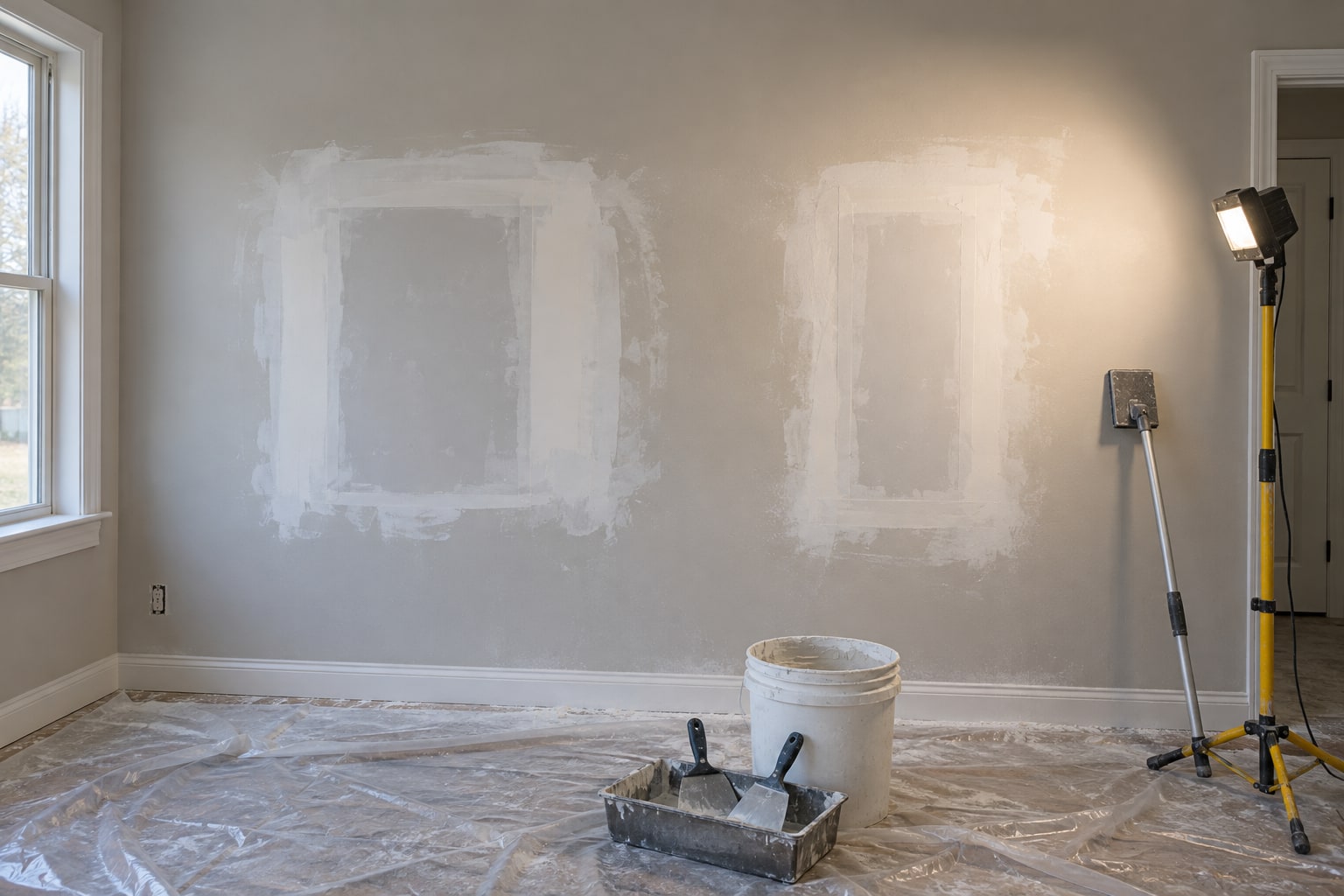
Sanding joint compound makes a fine dust that travels through a house and settles on every flat surface. The standard controls are plastic at the doorway, covered floors, covered furniture, and either a vacuum sander or wet sanding where the repair allows it.
Drying sets the schedule, not patching.Most repairs take two or three coats with sanding between them, and each coat has to dry before the next one goes on. Dry summer air here speeds that along.