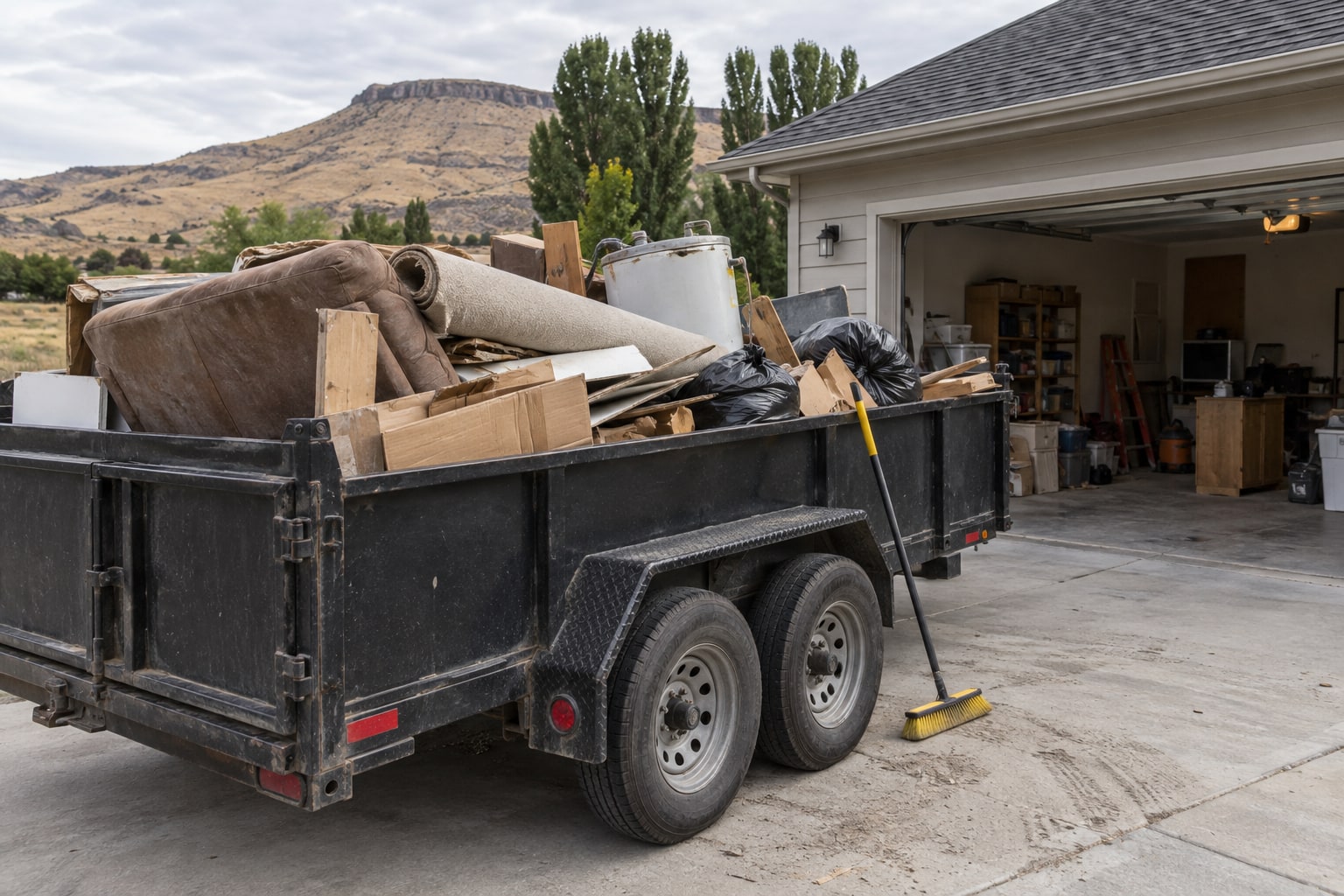
What this covers
Junk hauling in the Wenatchee Valley and the towns around it.
Removal & loading
- Household and property cleanouts
- Construction and yard debris
Sorting & hauling
- Heavy materials and access planning
- Reuse, recycling and disposal separation
What matters before the work
Three things decide what a haul costs, and none of them is how bad the pile looks. The first is volume, the space the material takes up in a truck or trailer.
Part of most piles cannot ride in a mixed load, and finding that out at the scale with a loaded trailer is the expensive version of learning it. Refrigerators, freezers, window air conditioners and dehumidifiers hold refrigerant, and a certified technician has to recover it before the shell can be scrapped or buried.
The climate explains why piles get large before anybody deals with them. The valley runs on roughly eight to ten inches of precipitation a year, so material left outside does not rot the way it would west of the mountains.
Questions
Junk hauling questions
The practical questions worth settling before the work starts.
What actually decides the cost of a junk haul?
Volume, weight and the carry. Volume is the space the load takes up. Weight is what the scale reads, and disposal is sold by the ton against a minimum, so a nearly empty trailer still pays that floor.
The carry is the part people leave out.Labor comes down to setups and round trips, so a pile within reach of the tailgate on a flat drive is a different job from the same pile behind a narrow gate or down a flight of steps.
How can a homeowner estimate how much is really there?
Pickup loads are the working unit. A full size eight foot bed filled level with the rails holds roughly two and a half cubic yards, and a short bed closer to two.
Weight is worth guessing separately, because it is the part that catches people out.Asphalt shingles run around two hundred and fifty pounds per hundred square feet of roof, per layer, so a small tear-off is heavier than it looks.
What will not go into a mixed load?
Household hazardous waste and anything with a disposal path of its own. Paint, solvents, pesticides, pool chemicals, motor oil, antifreeze, car batteries and propane cylinders go to a hazardous waste collection. Refrigerant appliances need a certified technician before the metal can be scrapped.
Older buildings add asbestos to the list.Popcorn ceilings, nine inch floor tile and the black mastic under it, pipe and duct wrap, and cement board siding on houses built before about 1980 are the usual suspects.
What about self hauling, or burning it?
Self hauling is legal and sometimes the right answer, with three catches. The load has to be covered and secured, which is enforced and which matters anyway on a windy valley highway.
Burning is a different answer.Outdoor burning of household garbage is illegal in Washington, and the burn barrel is the version of that most people picture.